Brand Protection
 SEM Insights
 Affiliate Compliance
 Ad Armor
 AI Search Insights
 Content Monitoring
 Learning Center
 Guides & Webinars
 We Love Data™
 About Us
 Our Data
 Careers
 Our Team
 News
News Contact Us
Brand Bidding Best Practices
Brand Bidding is your secret revenue weapon! We monitor data for millions of branded searches. Competition for these terms is on the rise and an effective, revenue-focused brand bidding strategy is the answer.
Let’s discuss the best practices of “how” to implement brand bidding campaigns.
What are the 7 commonly used branding strategies?
Businesses use a variety of branding strategies to position their products, differentiate from competitors, and scale growth. The most commonly used approaches include:
- Branded House: A single master brand spans all products and services (e.g., Google, Apple)
- House of Brands: Multiple distinct brands operate independently under one parent company (e.g., Procter & Gamble)
- Line Extension: Expanding an existing product line within the same category (e.g., new flavors, sizes)
- Brand Extension: Using an established brand name to enter a new category (e.g., Nike launching fitness apps)
- Co-Branding: Partnering with another brand to create a joint product or campaign (e.g., Nike x Apple)
- Ingredient Branding: Promoting a branded component within a product (e.g., Intel Inside)
- Private Label Branding: Producing products that are sold under another company’s brand (common in retail)
Set Objectives
Brand bidding campaigns should begin with clearly defined objectives to ensure your strategy aligns with broader business goals. Without measurable targets, it becomes difficult to evaluate performance or justify investment in branded search.
Set objectives for your brand bidding strategy such as:
- Target return on ad spend (ROAS) for branded campaigns
- Impression share ≥95% on core brand terms to maintain SERP dominance
- Incremental revenue lift from branded search (beyond organic baseline)
- Reduction in competitor or affiliate impression share on your brand keywords
By defining these benchmarks upfront, you can align bidding strategy, budget allocation, and monitoring efforts around measurable outcomes rather than tactical execution alone.
Keyword Development
As with any PPC campaign, brand bidding begins with effective keyword development. There are plenty of primers on keyword selection and keyword research tools on the web if you need to review the basics. These definitely apply to brand campaigns, too.
To start, find the brand and brand-plus keywords by reviewing your existing campaigns and analytics for generic terms that drive the best traffic. Then, add your brand terms in front of them (e.g., Burton + women’s snowboards on sale).
Next, combine your brand name with common search term appendages, such as:
- Brand + product name (“Burton snowboard”).
- Brand + review (“Burton Snowboard review”).
- Brand + discount (“Burton discount”).
- Brand + sale (“Burton sale”).
- Brand long tail (“used Burton Process Flying V Snowboard 2016 157W”).
- Brand + website (“www.Burton,” “Burton.com” or “Burton website”).
To improve control and performance, structure your campaigns to clearly separate branded and non-branded keywords:
- Build dedicated campaigns for branded vs. non-branded terms to control budgets independently
- Create separate ad groups for core brand terms, brand + modifiers (e.g., “brand + reviews,” “brand + pricing”), and defensive terms
- Apply distinct bidding strategies for brand campaigns to maintain high impression share at efficient CPCs
- Isolate reporting so brand performance can be measured without being skewed by prospecting campaigns
- Use campaign-level controls to quickly adjust spend, messaging, or targeting based on brand-specific performance trends
This structure allows for more precise optimization, clearer reporting, and better protection of high-intent branded traffic.
You can also check Google Autocomplete and related searches (at the bottom of the results page) for common searches on your brand.
The 5 steps in the PPC bidding process
A structured bidding process helps ensure your campaigns are aligned with business goals and continuously improving over time. Follow these five core steps:
- Define goals and KPIs
Establish clear objectives such as target ROAS, CPA, impression share, or revenue targets to guide bidding decisions - Research and segment keywords
Identify and group keywords by intent, separating branded and non-branded terms to enable more precise control and optimization - Choose a bidding strategy and set bids
Select the appropriate approach (manual or automated) based on your goals, and set initial bids to balance visibility with efficiency - Launch and monitor performance
Track key metrics like impression share, CPC, conversions, and competitor activity to ensure campaigns are performing as expected - Optimize and iterate
Continuously refine bids, budgets, and targeting based on performance data to improve efficiency and maximize results over time
Budget & CPC Management
Effective brand bidding requires dedicated budget control to prevent overspending and maintain efficiency. Brand campaigns should never compete for budget with non-brand or prospecting campaigns, as this can lead to underfunding high-intent traffic or inflating costs unnecessarily.
Separate a protected budget specifically for brand terms and manage it independently from other paid search efforts. This ensures consistent visibility on your most valuable queries, even during periods of budget constraint.
Monitor cost-per-click (CPC) on brand terms regularly. In most accounts, brand CPCs should be the lowest due to high relevance and quality scores. If CPCs begin to rise, it may indicate increased competition from affiliates or competitors, requiring closer monitoring rather than aggressive bid increases.
Invest enough to maintain top impression share and strong ad positioning, but avoid overbidding. The goal is to control the SERP efficiently, not to drive up costs on traffic you are already likely to capture organically. Avoid overbidding on brand; set bid caps and use Target Impression Share with a max CPC limit to prevent artificial CPC inflation.
Knock Competitors Off Page One
Competitors on your brand terms are there to steal your clicks and piggy-back on your good name. Competitors can cause you to lose clicks and increase CPCs on your brand terms. Or worse, they can overtake you in rank, pushing you down the page.
Your number one goal is to remove as many competitors as you can. The search engines will help you with this exercise. Start by familiarizing yourself with the engines’ trademark policies. If your brand is trademarked, enforcement shouldn’t rely solely on manual checks and reporting. Instead, use a monitoring platform like The Search Monitor to automatically detect and document trademark violations across search engines.
The Search Monitor continuously scans paid search results to identify competitors or affiliates using your brand name in ad copy. When violations are found, the platform provides evidence and reporting tools that streamline the enforcement process, making it easier to take action at scale rather than chasing issues one by one.
By leveraging automated monitoring and enforcement workflows, you can more efficiently protect your brand, reduce unauthorized usage in ad text, and maintain control over how your brand appears in the SERP.
Then, be vigilant in monitoring your brand terms. If you find a competitor who is using your name in ad copy text, be relentless in reporting these competitors to the search engines. Report any competitive advertiser that uses your brand name in their PPC ad title or copy. (Remember that it’s okay if your brand appears in the ad’s Display URL, which engines allow.)
To effectively defend your brand position, implement a consistent monitoring routine:
- Track impression share (IS) on core brand terms daily to ensure full coverage
- Monitor Top Impression Share and Absolute Top Impression Share to maintain dominant positioning
- Review CPC trends to identify cost inflation from increased competition
- Analyze competitor impression share to detect new or aggressive bidders
- Adjust bids and apply negatives as needed based on performance and competitive shifts
- Log weekly who appears in Auction Insights on core brand terms; track new entrants, IS overlap, and outranking share to trigger takedown or bid responses.
Maintaining this level of visibility allows you to respond quickly to changes in the auction and protect your brand presence on the SERP.
The search engines have compliance departments that are set up to review your complaints. If an ad infringes on their policies, the engine will take the ad down immediately. If the ad does not infringe, the search engine will allow the ad to continue to run. If the latter happens, don’t take it personally.
And don’t worry about getting penalized for this. Search engines expect some level of complaints and are prepared to handle your inquiries. If you can automate the reporting process, you should.
The next best thing to a take-down is to beat your competitors in rank. You never want your competition to bid above you on your own brand terms, so it’s important to monitor your brand terms daily and adjust your bids accordingly.
If your take-down attempts end up failing, it is most likely because the competitor is not using your brand name in its ad copy. By not using your name, the competitor’s ads are likely not very relevant to the search term, which will cause their quality score to decline and their CPCs to increase. Their costs will balloon as a result, which is what you want, since it allows you to outbid them.
Sure, they could ignore return-on-ad-spend (ROAS) and continue brand bidding just to be jerks, but let them spend the money. You can also cause them additional pain by cranking up the heat with partner arrangements.
Work With Partners & Affiliates
If you sell online, having an affiliate program can help you dominate page one, drive more revenue, manage costs and build your brand. By carefully selecting a group of your best affiliates to work with you, you can use this powerful cost-cutting technique that can also boost clicks and sales.
We will dive deep into partner and legal issues later in this guide, but here are the basics:
- Identify a group of affiliates that you will allow to brand bid.
- In your contracts, clearly spell out that no affiliate can rank above you in branded PPC.
- Ensure affiliates have more relevant ad copy than your competitors by helping them to describe your products and services in depth in their ads and landing pages.
- As you mature the program, consider whether you should remove brand-bidding rights from all but your best three affiliates. This helps make sure your CPCs don’t get out of control.
As your affiliate program evolves, it’s important to regularly evaluate whether affiliate brand bidding is truly driving incremental value or simply capturing demand you would have converted anyway.
Assess performance using metrics such as:
- New-to-brand orders or customers driven by affiliate activity
- Assisted conversions and upper-funnel contribution
- Incremental revenue lift compared to baseline brand performance
- Changes in CPC and overall cost efficiency as more affiliates bid on your terms
If affiliate activity leads to rising CPCs or increased cannibalization without clear incremental gains, consider restricting brand bidding rights to a smaller group of high-performing partners. Platforms like The Search Monitor can help track affiliate behavior, measure overlap, and identify which partners are adding value versus inflating costs.
Taking a data-driven approach ensures your affiliate strategy supports growth rather than eroding the efficiency of your brand campaigns.
Affiliate management and coordination takes constant vigilance. (Sorry, there are no freebies in PPC!) This is accomplished with dedicated personnel and PPC monitoring tools that can automate the detection, reporting and communication with affiliates and the engines.
Affiliate Governance Playbook
A structured governance framework ensures affiliate brand bidding supports growth without inflating costs or creating channel conflict. Define clear rules, monitoring processes, and enforcement protocols to maintain control.
- Allowed terms and restrictions
Specify which branded keywords affiliates can and cannot bid on (e.g., prohibit core brand terms, allow long-tail or modifier queries only) - Rank and positioning guidelines
Set expectations for where affiliates can appear (e.g., do not outrank the brand on core terms, restrict top-of-page placements) - Commission adjustments
Align payouts with value by reducing or eliminating commissions on low-incrementality brand traffic, while rewarding partners who drive new-to-brand customers - Violation identification and workflow
Establish a clear process for handling violations, including detection, documentation, partner notification, and escalation if issues persist - Reporting cadence
Review affiliate activity on a consistent schedule (daily or weekly depending on scale) to track compliance, CPC trends, and performance impact - Tool-based monitoring and enforcement
Use platforms like The Search Monitor to automatically track affiliate bidding behavior, identify violations, and generate reports that support faster, scalable enforcement
Implementing this playbook helps ensure affiliates contribute incremental value while protecting the efficiency and integrity of your brand campaigns.
Ad Copy Tips
In addition to the standard best practices for ad copy and landing pages, like title-matching your keyword, here are other best practices for brand bidding:
- Official Site. Consider using “official site” in your ad copy. An ad title like “Burton Official Site” can draw clicks away from wanna-be competitors and significantly increase your CTR.
- Landing Pages. Make sure your landing page is paying off what your searchers are being promised. Nobody likes clicking on an ad for blankets and getting a page for shoes — or even worse, seeing the dreaded 404 error page.
- Ad Extensions. Be sure to use ad extensions, specifically site links. Site links will make your ad BIGGER! Big ads take up more room, which pushes competitors down on the page. You can also add business phone numbers, third-party reviews (if you sell products) and display a local address if you have retail locations. I also encourage you to use call-out extensions to add offers, brand slogans or “official reseller” status.
- Offers. In an analysis of offers run in skin care ads over the Q4 holidays, The Search Monitor found that 69 percent of ads mentioned free shipping, 22 percent mentioned a sale and six percent offered a free product. Highlighting offers like these can make your ad more enticing and potentially increase clicks as a result.
Write unique ad copy that highlights USPs (e.g., warranty, returns, pricing, inventory) and matches the searcher’s intent; align headlines and paths to the exact brand term. Keep in mind that if you have a strong brand, and you can show your value in the ad copy, then you might not need an offer. Before you decide, evaluate the competitive landscape.
Be First In Mobile
Remember what Ricky Bobby said, “If you ain’t first, you’re last!” This is true with mobile, where only one or two paid ads (and often no organic results) can appear above the fold. You’d better focus on being #1.
For example, here is a search on the Burton brand, and you can see only one listing. Burton makes use of site links, a phone number and an offer. Notice how BIG their ad is!
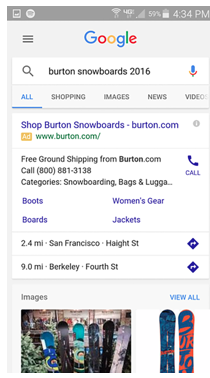
The pole position is clearly good for traffic and conversions. Google recently announced that more searches take place on mobile devices than on computers. Our client and retail super affiliate, Savings.com, shares that on their mobile website, CTR drops from 30 percent in the first position to 12 percent in second position.
Measure Incrementality & When to Bid on Brand
Not all brand bidding drives incremental value. To ensure you’re not simply paying for traffic you would have captured organically, it’s critical to measure incrementality and define when to scale or pull back spend.
Use the following approaches to evaluate performance and guide decisions:
- Run pause tests on brand campaigns
Temporarily pause brand ads in controlled windows to measure impact on total traffic, conversions, and revenue versus baseline performance - Analyze the Paid & Organic report
Compare paid and organic click share on brand terms to understand overlap and identify whether ads are driving incremental visibility or cannibalizing organic results - Leverage Auction Insights
Monitor competitor impression share, overlap rate, and outranking share to determine how aggressively others are bidding on your brand - Review attribution models
Use multi-touch attribution to assess whether brand campaigns assist conversions or simply capture last-click credit - Set clear thresholds to scale or pause
Scale brand bidding when competitor presence is high, impression share drops, or incremental lift is proven
Reduce or pause spend when organic coverage is dominant, CPCs rise without added value, or cannibalization increases
By consistently applying these methods, you can make informed decisions about when brand bidding is truly driving growth versus when it’s eroding efficiency.
Piggy-backing On Other Brands
Piggy-backing is a technique where you brand bid on a competitor’s brand name. I just spent most of this section discussing how to brand bid on yourself. Now, we will discuss brand bidding on your competition.
Who can benefit from piggy-backing?
- Small Brands. Small, lesser-known brands can use piggy-backing to ride the coattails of a bigger competitor.
- Big Brands With Competing Products. If you are a big brand with a better product than your competitor, you can use this tactic to tell the marketplace about your superior products.
In order to piggy-back effectively, you will need to follow these rules:
- Ad Copy. Do not use the brand in the title or description of your ad (You will get your ad taken down).
- Comparisons. Make sure that your ad is focused on comparing yourself to the competitor’s product or brand (in a legal, non-derogatory way).
- Display URL. Use their brand in your display URL. This will make your ad relevant, protecting your Quality Score (e.g., mydomain.com/yourbrand-vs-theirbrand).
- Landing Page. Make sure the landing page is targeted to the comparison that you espouse in your ad. It must thoughtfully and accurately compare your features and benefits. If you can, find a third party who has done the comparison for you.
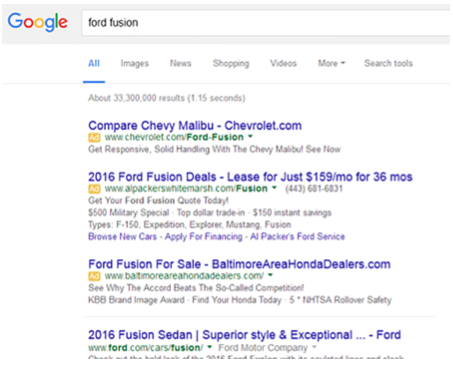
Here is a great example of this tactic deployed by Chevy against Ford to promote the differences between its Malibu brand and the Ford Fusion. Notice how Chevrolet is ranked first for “ford fusion”. The ad copy does not mention Ford. The display URL contains the Ford Fusion brand and takes the user to a comparison page.
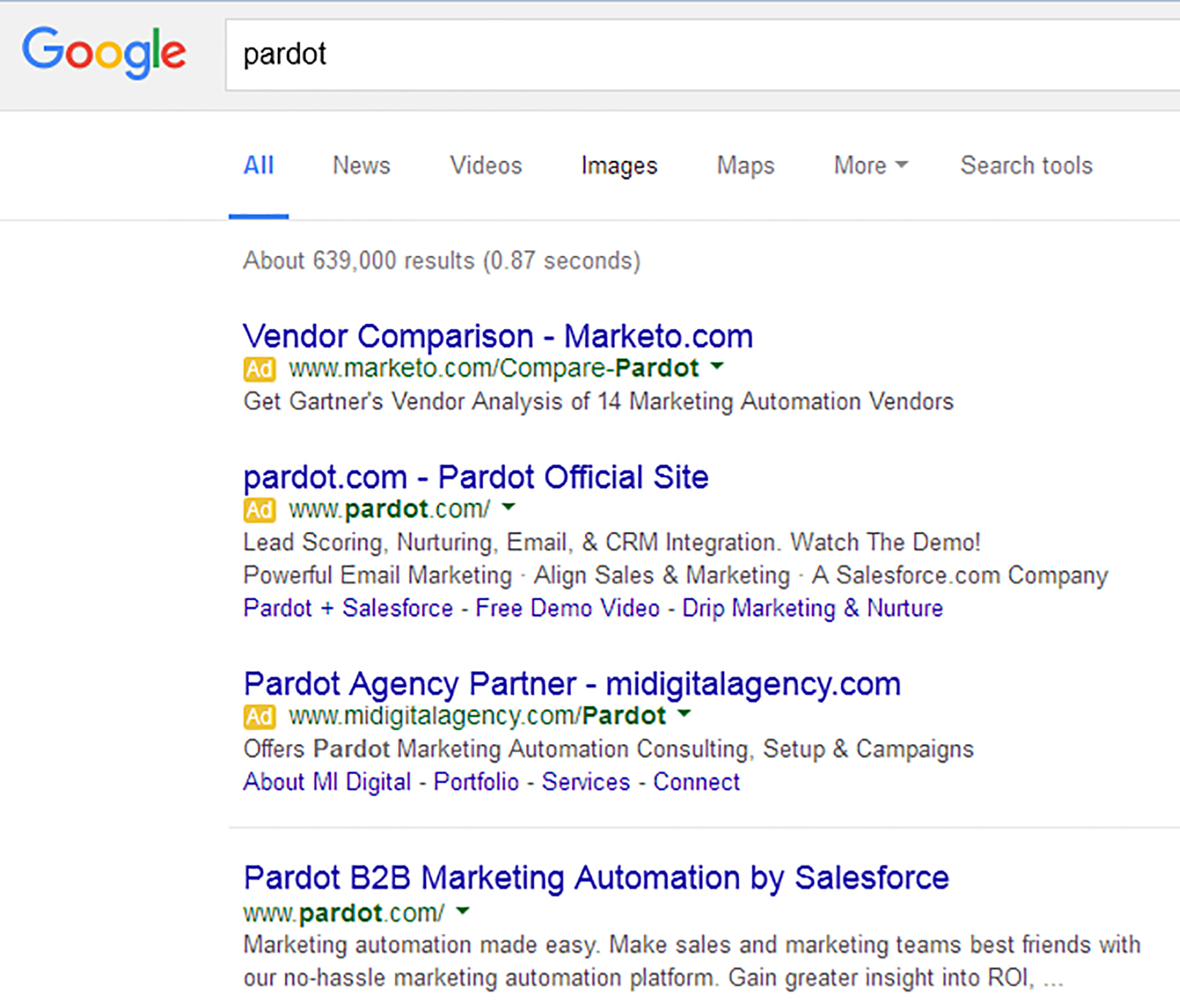
Okay, now let’s discuss another great example of piggy-backing. In the screenshot below, two giants of marketing automation, Marketo and Pardot, are battling it out in PPC. Marketo is advertising on Pardot’s brand name.
Notice again, as in the example above, how Marketo is ranked first and links its ad to a comparison landing page to make its case. If you were a smaller player in marketing automation (e.g., Net-Results.com, which markets on how it can compete with the industry leaders), you could be capitalizing on this same piggy-backing strategy.
Ready to implement or improve your brand bidding strategy? Schedule a demo and we’ll help!
FAQs:
What’s the optimal campaign structure for branded terms?
Create dedicated brand campaigns and ad groups segmented by intent (pure brand, brand + product, brand + discount/review/misspellings). Apply tighter budgets/targets, exact/phrase match mapping, and dedicated landing pages. Keep non‑brand separated to avoid budget masking and ensure clean KPIs.
What should we do when affiliates bid on our brand and inflate CPCs?
Implement governance: whitelist only select partners, restrict ranking above the brand, define allowed/blocked terms, and require compliant ad copy/landing pages. Monitor auctions and ad copy, identify violators, adjust or withhold commissions for non‑incremental traffic, and enforce takedowns for policy breaches.
How do evolving SERP features impact the need to bid on brand?
With up to four top ads, larger ad formats, and features like Shopping, local packs, and PAAs pushing organic down, even a #1 organic listing can be below the fold. If competitors or resellers appear, branded ads help secure top coverage, control messaging via extensions, and reduce lost clicks from interception.
Share on Social
See Our Data at Work
Provide us with a competitor’s website, a set of keywords, or one of our 1,000+ verticals, and we’ll show you the power of our monitoring capabilities. Request a personalized demo today and see what our insights can do for you!
Trusted by